After the Spokane Fires: Finding Rest, Mercy, and Hope in Christ
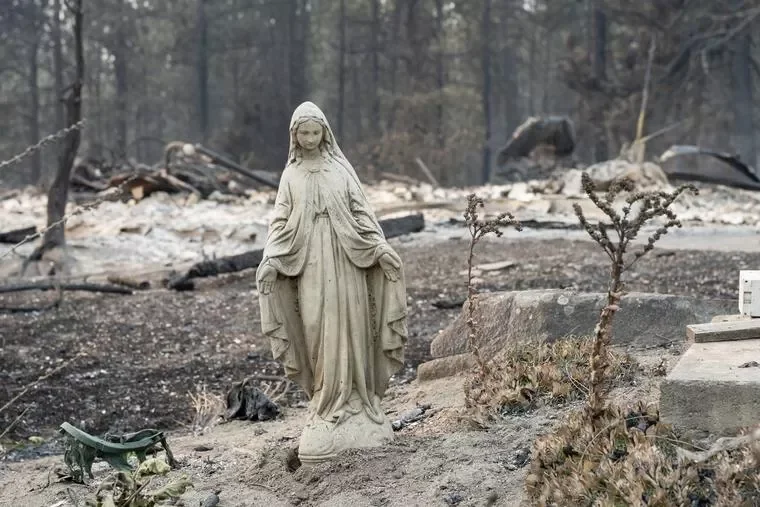
A Virgin Mary statue remains untouched in front of a burned residential home in the Balboa neighborhood of Spokane, Washington, on Aug. 2, 2026. Fast-moving fires left a trail of destruction in the northwestern U.S. city of Spokane on Sunday, with officials reporting hundreds of structures reduced to cinders. Thousands of people were ordered to evacuate their homes Saturday and overnight into Sunday. (photo: Erick Doxey / AFP via Getty Images)
Wildfires disrupt far more than homes and neighborhoods. They can unsettle our sense of safety, interrupt routines, separate families, and leave behind grief, fear, exhaustion, anger, and uncertainty.
As a Catholic counselor, I believe recovery involves caring for the whole person—body, mind, and soul—and remembering that suffering is not meant to be carried alone.
Jesus offers us this invitation:
“Come to me, all you who labor and are burdened, and I will give you rest.”
— Matthew 11:28
For those affected by the Spokane fires, that rest may not mean that every practical problem is immediately resolved. It may mean receiving enough grace for today: a safe place to sleep, a meal, a conversation with a friend, time in prayer, or someone willing to sit with us in grief.
Receiving Rest by Caring for the Whole Person
After an evacuation or frightening event, people may experience anxiety, difficulty sleeping, irritability, sadness, fatigue, intrusive memories, anger, or feeling constantly on alert. These can be understandable responses to an abnormal situation.
Part of receiving Christ’s rest is allowing ourselves to care for the needs He has given us as human beings. Healing often begins with simple steps: reconnecting with supportive people, restoring routines, eating and sleeping regularly, limiting distressing news, and allowing time to grieve.
Our faith can also provide stability. Mass, Eucharistic Adoration, the Rosary, Scripture, Confession, and simple honest prayer can help us remain connected to Christ when life feels uncertain.
Prayer does not have to be complicated:
“Jesus, I am afraid.”
“Lord, help my family.”
“Jesus, give me strength for today.”
Trusting God in Uncertainty
As immediate needs are addressed, deeper questions often remain: Why did this happen? What comes next? How will we recover?
Faith does not require us to pretend that loss does not hurt. Scripture is filled with people who bring fear, anger, sorrow, and uncertainty before God. We can lament honestly while continuing to trust in His faithfulness.
God’s faithfulness does not mean that we will be spared every hardship. It means that we are not abandoned within hardship. Christ often makes His care visible through ordinary people—a neighbor bringing a meal, a parish providing clothing, a friend making a phone call, or a family offering temporary shelter.
Anger, Resentment, and Forgiveness
When destruction results from another person’s deliberate actions, anger can become part of the grief. For those who have lost homes, possessions, livelihoods, pets, or a sense of safety, that anger is understandable.
As Catholics, we are called both to justice and to love of our enemies. Applying this biblical approach activates our anger as a passion for good in three ways:
✦ Anger can make us holy.
✦ Anger can motivate us to work for justice.
✦ Anger can fuel our zeal for evangelization.
Thus, we can support appropriate legal consequences to work for justice while also praying for repentance and conversion of the offenders rather than sinful anger of hatred or personal revenge.
If left unacknowledged or unexpressed, anger can fester into resentment, becoming another burden. It is often compared to holding a hot coal while hoping someone else will be burned by it. This disordered passion may feel protective at first, but often not controlled and carrying this indefinitely can wound us as well.
Thus, forgiveness is often a process of feeling and expressing the unspoken anger, unmet needs, and boundaries crossed. It may begin with:
“What happened was wrong. I am angry and hurt. I may not feel ready to forgive, but I do not want this wrongdoing to control my heart.”
We can allow justice to take its proper course while surrendering our desire for personal revenge to God: Thy will be done.
A simple prayer may be:
“Jesus, grant me the grace to desire forgiveness. Help me to will the good of the other.”
Forgiveness does not mean saying, “What happened was okay.” It means refusing to let what happened have the final word over our hearts.
The Corporal Works of Mercy
The fires also give our Catholic community an opportunity to live the corporal works of mercy in a concrete way: feeding the hungry, clothing those in need, sheltering displaced families, and caring for those who are suffering.
Jesus tells us:
“Whatever you did for one of these least brothers of mine, you did for me.”
— Matthew 25:40
When we serve those most affected by the fires, we are serving Christ Himself.
That might mean donating food or clothing, helping a family navigate paperwork, providing transportation, supporting first responders, offering temporary housing, or simply listening to someone who needs to tell their story.
No act of mercy is too small.
Call someone. Check on a friend, neighbor, or parishioner who has been affected.
Give something. Consider donating to a local parish or relief effort providing food, clothing, housing, and other necessities.
Pray for someone. Pray for displaced families, those who lost homes, firefighters, first responders, and everyone facing difficult decisions in the weeks ahead. Please also pray for those responsible for the Old Trail fires and any other acts of arson, asking God for their repentance, conversion, and healing.
And if you are the one who needs help, allow yourself to receive it. We belong to one Body, and at different times we are called both to carry others and to let others carry us.
Hope After the Fire
Recovery will look different for every family. Some will rebuild homes. Others will rebuild routines, finances, relationships, trust, or a sense of safety.
Catholic hope does not depend on everything returning exactly to the way it was. Our hope rests in Christ, who remains faithful in both consolation and desolation.
The fire does not have the final word. Neither do fear, anger, loss, or uncertainty. Christ does.
May our parishes become places where people can grieve honestly, receive practical help, work through anger without being consumed by it, and rediscover that they are not alone.
“Come to me, all you who labor and are burdened, and I will give you rest.”
May we receive that rest ourselves—and recognize Christ in every person we are given the privilege to serve.
For additional support, please see our resource developed in collaboration with the Cathedral of Our Lady of Lourdes for helping children and families recover after the Spokane fires.