Why Reassurance Feeds OCD

What Is Reassurance?
Reassurance is comfort, validation, advice, or confirmation intended to reduce anxiety and increase confidence. In everyday life, reassurance can be healthy and helpful. It can help us navigate uncertainty, difficult emotions, and challenging situations.
With OCD, however, reassurance can become part of the compulsive cycle.
Reassurance often provides temporary relief by creating a sense of certainty.
Imagine a fire alarm that keeps going off even though there is no fire. Each time the alarm sounds, someone comes in and says:
“There is definitely no fire. You are safe.”
For a moment, the anxiety goes down.
But eventually, the alarm sounds again.
This can happen with scrupulosity.
A person asks a priest:
“Was that a mortal sin?”
The priest responds:
“No. You’re okay. It was not a mortal sin. Any other questions?”
Or someone asks a parent, spouse, or friend:
“Do you think I did something wrong?”
They respond:
“It’s not a big deal. You’re fine. Don’t worry about it.”
The reassurance feels comforting. But when reassurance becomes compulsive, it does not teach the person that they can tolerate uncertainty. Instead, it can teach the brain:
I need someone else to make sure I’m okay before I can move forward.
In this way, reassurance seeking can become a way of neutralizing distress and reducing the perceived responsibility or uncertainty attached to a situation. It can bring tremendous relief in the moment.
The problem is that the relief does not last.
Over time, the brain may begin reaching for reassurance whenever uncertainty appears.
Repeated reassurance can also erode confidence. Instead of learning, I can tolerate uncertainty and move forward, the person increasingly feels the need to check again.
OCD asks:
“But are you sure?”
Reassurance answers:
“Yes, I’m sure.”
And eventually OCD asks again.
OCD is rarely satisfied for long.
The Reassurance Cycle
A common OCD cycle looks like this:
Doubt → Anxiety → Reassurance Seeking → Temporary Relief → More Doubt
The problem is not that reassurance feels comforting.
The problem is what the brain learns from it.
When reassurance repeatedly lowers anxiety, the brain is conditioned to associate uncertainty with reassurance seeking occurring before the person can move forward.
This is why reassurance seeking can become so persistent and why it is one of the most common OCD compulsions.
Family members, friends, spouses, and even clergy may understandably want the person with scrupulosity or OCD to feel better. They may repeatedly answer questions because they want to help.
But repeated reassurance can unintentionally strengthen OCD by teaching the person to return for another answer whenever doubt appears.
The goal is not to eliminate all reassurance or emotional support.
The goal is to help someone experience anxiety, doubt, and uncertainty without repeatedly seeking reassurance to make those feelings disappear.
A helpful distinction is:
Ask to become informed—not repeatedly to become reassured.
Then work on finding other ways to receive emotional support without feeding the compulsion.
This is one of the skills developed through Exposure and Response Prevention (ERP).
What Does Reassurance Seeking Look Like?
Reassurance seeking is often used to reduce an immediate sense of risk, guilt, responsibility, or uncertainty.
Reassurance seeking can look like:
Compulsively searching online for answers
Repeatedly asking whether a relationship is okay
Repeatedly checking whether doors are locked or whether something bad might happen
Asking whether something you said or did was sinful
Seeking confirmation about past conversations
Asking others to validate a moral decision
Seeking multiple people’s perspectives on the same moral question
Research suggests that reassurance may reduce anxiety in the short term, but repeated reassurance can reinforce the urge to seek certainty again when doubt returns (Salkovskis & Kobori, 2015). Another study found that greater reassurance seeking may be associated with increased guilt and other negative emotions in OCD (Haciomeroglu, 2020). These findings share the long-term effects when reassurance seeking becomes an OCD compulsion. Yet, there are alternatives to challenge the reassurance cycle.
Information-Seeking vs. Reassurance-Seeking
Not every question is a compulsion.
Asking questions and seeking appropriate guidance are normal and healthy.
The more important question is often:
What am I hoping this answer will do for me?
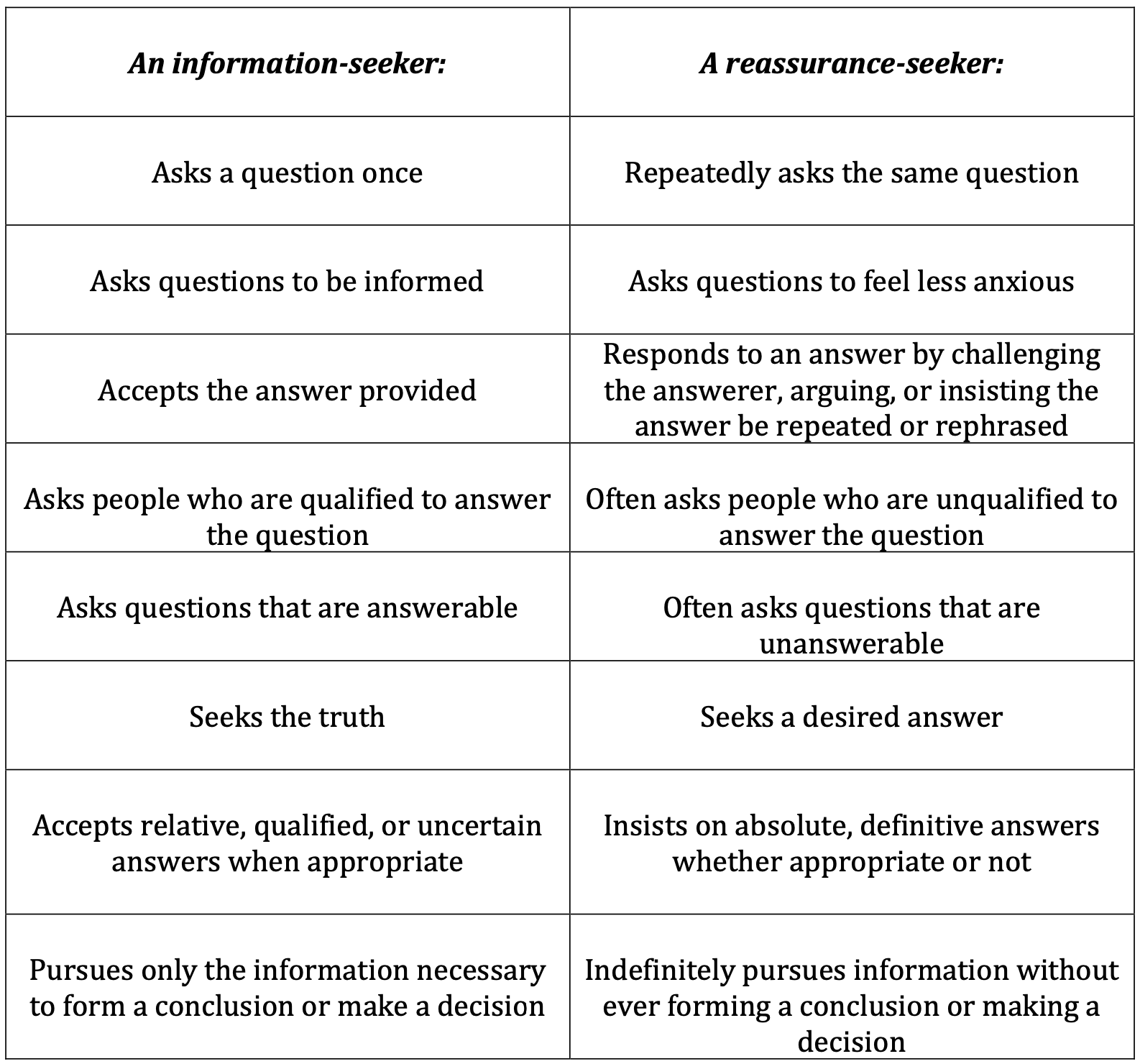
For example, someone with scrupulosity may appropriately ask a trusted priest a moral question.
They receive an answer.
Then OCD may say:
“Maybe I explained it incorrectly.”
“Maybe Father misunderstood.”
“What if I left out an important detail?”
“Maybe I should ask another priest.”
“Maybe I should ask one more time, just to be sure.”
At that point, the question may no longer be primarily about receiving moral guidance.
It may have shifted toward obtaining certainty and reducing anxiety.
That distinction matters.
Supporting Someone Without Feeding OCD
The goal is not to prevent someone from asking questions or to withdraw support.
Simply telling family members to stop offering reassurance can be unhelpful and, in some cases, counterproductive.
A better approach is to help the person recognize the urge for reassurance and respond differently with emotional support instead.
Recent research supports this distinction. Causier and Salkovskis examined emotional support as an alternative to reassurance. Participants with OCD rated emotional support as more helpful and acceptable than reassurance, and emotional support was associated with a lower anticipated urge to seek further reassurance (Causier & Salkovskis, 2025).
A loved one might say:
“You already received an answer to that question. I know the uncertainty is uncomfortable. How can I support you without helping you check again?”
This shifts the focus away from answering the OCD question and toward helping the person tolerate the discomfort.
Emotional support might sound like:
“I know this feels difficult.”
“You can handle the uncertainty.”
“You don’t have to solve this feeling right now.”
“I’m here with you while the anxiety passes.”
Instead of simply telling family members to stop providing reassurance, it may be more helpful to teach them how to shift from certainty-giving to emotional support.
The goal is not to leave the person alone with their anxiety.
The goal is to remain supportive while helping them practice tolerating uncertainty.
Faith and Uncertainty
For Catholics struggling with scrupulosity, reducing reassurance seeking does not mean becoming indifferent to sin or abandoning a well-formed conscience.
Rather, it often means learning when sufficient moral guidance has already been received and resisting OCD’s demand for perfect certainty.
There is an important difference between seeking faithful guidance and repeatedly checking because anxiety demands another answer.
In Catholic OCD and scrupulosity treatment, the goal often involves learning to trust a well-formed conscience, follow the guidance of a trusted confessor, and allow uncertainty to remain without repeatedly trying to eliminate it.
Faith itself does not require perfect emotional certainty.
Sometimes the faithful response is:
I have received appropriate guidance. I may still feel uncertain, and I can move forward anyway.
That is not carelessness.
It is learning to act by faith in God without giving OCD the final word.
A Simple Rule of Thumb
A helpful starting point is:
Ask for the information you reasonably need, receive the answer, and practice resisting the urge to check again.
When the urge to ask again appears, pause and consider:
Am I looking for information, or am I looking for relief?
Rather than repeatedly asking someone else to settle the doubt, look for other ways to receive support while allowing uncertainty to remain.
ERP helps people with OCD strengthen this ability over time.
The goal is not perfect certainty.
The goal is greater freedom and greater faith in the uncertainty.
If this blog resonated with you and you struggle with OCD or scrupulosity, consider reaching out to schedule a consultation to determine whether Catholic OCD treatment may be a good fit for you.
References
Causier, C., & Salkovskis, P. (2025). Fighting OCD together: An experimental study of the effectiveness and acceptability of seeking and receiving emotional support for OCD. Journal of Behavior Therapy and Experimental Psychiatry, 86, 101987. https://doi.org/10.1016/j.jbtep.2024.101987
Haciomeroglu, B. (2020). The role of reassurance seeking in obsessive compulsive disorder: The associations between reassurance seeking, dysfunctional beliefs, negative emotions, and obsessive-compulsive symptoms. BMC Psychiatry, 20, 356. https://doi.org/10.1186/s12888-020-02766-y
Salkovskis, P. M., & Kobori, O. (2015). Reassuringly calm? Self-reported patterns of responses to reassurance seeking in obsessive compulsive disorder. Journal of Behavior Therapy and Experimental Psychiatry, 49(Part B), 203–208. https://doi.org/10.1016/j.jbtep.2015.09.002