
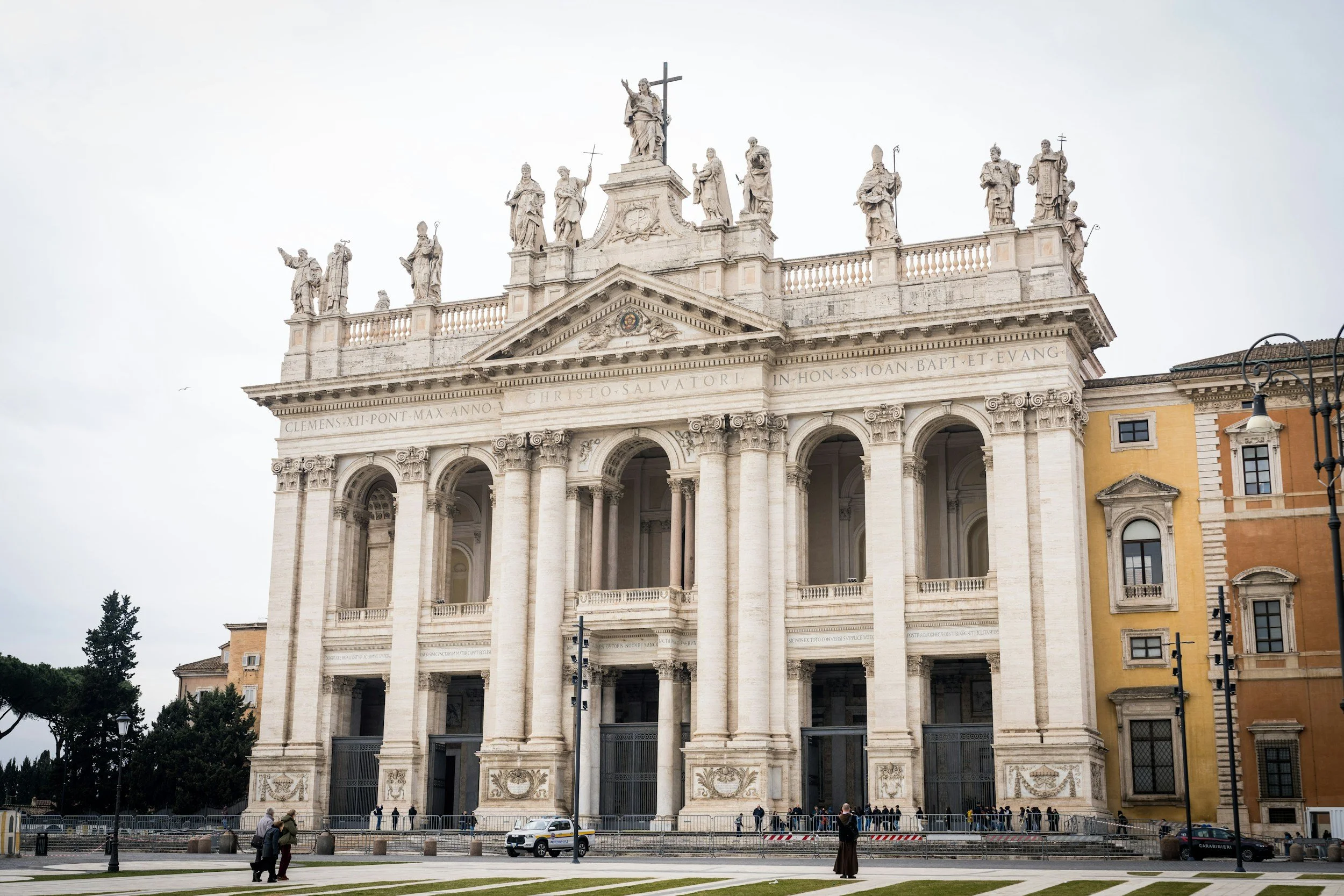
“Do you not know that you are the temple of God, and that the Spirit of God dwells in you?”
Today the Catholic Church celebrates the dedication of the Pope’s church, St. John Lateran. (As we were reminded in the homily this morning, St. Peter’s Basilica is not the Pope’s church. It’s the Universal Church’s home!)
The readings for today’s feast connect the Church as a place of worship and a life-giving source for the Body of Christ with the truth that each of our bodies is meant to be a temple of the Holy Spirit. I love this imagery on so many levels.
Today I’d like to talk about how this relates to counseling, and what makes Catholic counseling, or perhaps I should say counseling by a Catholic, fundamentally different from any other counseling in the mental health profession.
First, to reiterate: the Church celebrates the dedication of churches as a feast, much like a feast of the saints, because it is significant for understanding who we are in relationship to God. The desire is to keep our lives theocentric rather than egocentric. We quickly fall out of order if our lives are not centered on God, and we quickly forget to center them on God if we do not have physical reminders in places that bring us into His presence.
What I love about our Catholic faith is that it is not either/or but a both/and paradox: the Church must be a physical, beautiful place, and we too are called to be churches, temples, dwelling places of God.
So, as in the readings for today, we recognize something special that God is revealing to us through His Word about who we are as persons: that the person is a temple and a dwelling place for God.
This great mystery is so profound, and so hardly visible to our ordinary eyes, that it takes great intention and practices like prayer (that is, deeper contemplation) to bring us into union with God and help us feel this reality more fully.
Ultimately, we live out this image of a church when we live in a state of grace, specifically sanctifying grace, which comes to us through two primary pathways:
Through our baptism, where we are freed from original sin and brought into God’s family in a more metaphysical reality.
Through maintaining a state free from mortal sin, or returning to confession when we fall into mortal sin.
Here is the tension in this life and our choices: for something to be considered a mortal sin, it must be of grave matter, it must be known to be of grave matter, and it must be freely chosen. Only then does it fully qualify as mortal sin.
This complex dynamic between baptism and maintaining a life of grace is essential to fully living out the reality that is deeper than our physical reality (hence the metaphysical), the reality that allows us to be temples in full expression as human beings, as persons.
So how does this relate directly to the counseling experience, and what might the Church tell us about counseling?
First, let us recognize that counseling is based on the psychological sciences, whether in the psychoanalytic or insight-based mode, the cognitive-behavioral school, or the tools-based mode. These approaches can be efficacious to the degree that they correspond to truth in science and to our psychological experience.
To push that further and understand the psychological in relationship to our fallen nature, we recognize that every person is created with an intellect and a will. The effect of sin is that it darkens the intellect and weakens the will. So this connection to our understanding of the Church, and to our understanding of our bodies as temples of the Holy Spirit, reveals something essential about the expression of the psychological.
“...it is worth considering the significant difference of receiving counseling from a fellow Catholic who understands how grace works in the soul...”
In plain language, when a counselor is serving a Catholic and is not in a state of grace, there is a temple effect missing from the encounter. There is also a darkened intellect that does not understand the workings of grace within the soul of the Catholic client. That is why it is worth considering the significant difference of receiving counseling from a fellow Catholic who understands how grace works in the soul and how the person before them stands as a temple of the Holy Spirit. To understand this is, in effect, to begin the process with an appreciation for the other person’s dignity in the life of the Church, the Body of Christ, the life of God in the soul.
To be clear, this difference in perception, this difference in the paradigm, the map, the worldview of the clinician, is going to affect the experience as a whole. Much research has shown that the most pivotal element of the counseling process is the relationship between clinician and client. This is not to deny or devalue the excellence of certain clinicians in the field, but it highlights for us the value and the gift of being Catholic counselors who seek to guide clients into the experience of being fully alive as temples of the Holy Spirit.